WHERE DO I GO FROM HERE?
February 5, 2026
All Junior Athletes Should See Shooting as a Sport that Offers an Exciting Future
By Gary Anderson, DCM Emeritus
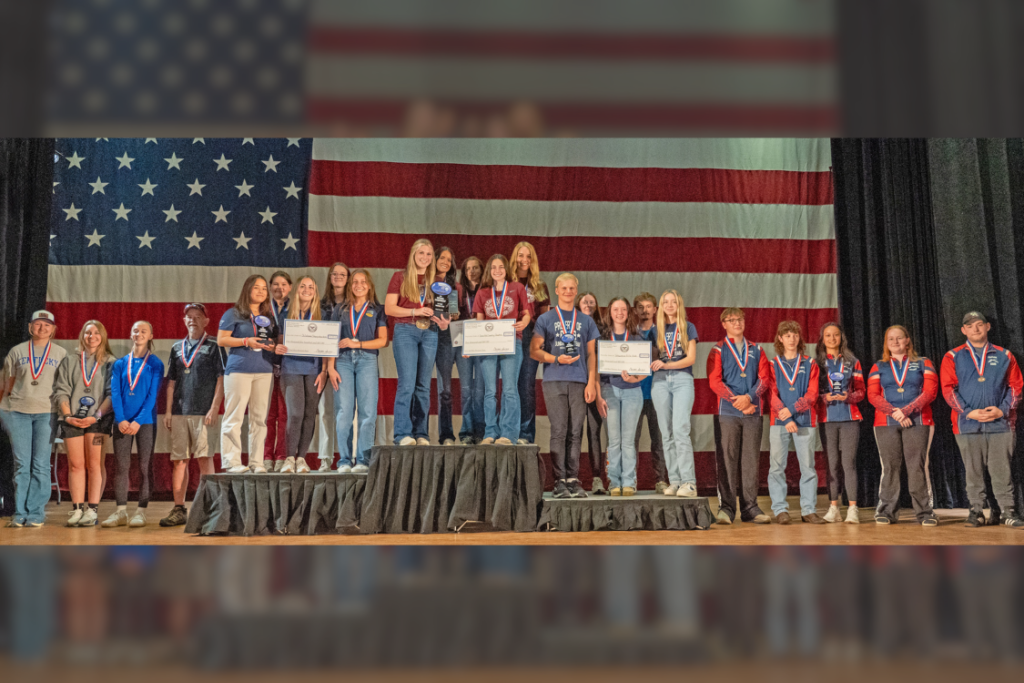
One of the most serious problems in American Shooting is that Junior competitors age out of their Junior programs without any sure paths to their further participation in Shooting as young adults. Juniors in BB Gun programs cannot participate after their 16th birthday. Juniors in Three-Position Air Rifle and members of JROTC Rifle Teams conclude their eligibility when they graduate from High School.
Most Junior Rifle Club members face similar fates when they leave high school. Even NCAA rifle or club rifle or pistol team members no longer have a shooting program after they leave college. Each year thousands of Juniors age out of their Junior programs and drop out of Shooting. In contrast to this problematic situation in the USA, Juniors in Germany and many other countries shoot Junior competitions through shooting club programs that teach them how to shoot, offer them Junior competition opportunities and then when they are no longer eligible to compete as Juniors, opportunities to practice and shoot in open or Senior competitions. There they can continue to practice and participate in recreational and traditional shooting events or compete in club, state and national competition in the same club that got them started.
Shooting is a sport that can be practiced by 10- or 12-year-old air gun shooters as well as by 70- and 80-year-olds who still compete in rifle or pistol events. Participants in Junior programs where they will inevitably age out must learn to see Shooting as a sport that offers many exciting participation opportunities for them when they become adults with its new responsibilities for family and career. This On the Mark article is written for Junior shooters, as well as for their parents, coaches and friends, who are looking ahead to the time when they can no longer compete as Juniors. This article is for Juniors who can say, “I enjoy shooting and I would like to find a way to continue in this sport after I am a Junior.” It explores many possibilities for their continued marksmanship participation as rifle or pistol competitors.
THE FOUNDATION FOR FUTURE SUCCESS IS ALREADY THERE. Junior shooters will have already learned the knowledge and skills they need to participate in many shooting disciplines. They know how to be safe with guns. They know how to conduct themselves safely on shooting ranges and how to follow Range Officer commands and instructions. They know how to follow Shooting discipline rules. Most importantly, Juniors who were in good basic marksmanship programs have the foundational skills needed to quickly adapt to most Senior competition courses of fire. They know how to assume stable firing positions and perform correct shot technique. Many will have had extensive experience in shooting competition courses of fire. These skills are readily transferrable to different Shooting disciplines that offer active futures like Rimfire Sporter, Smallbore Position, Match Pistol or Service Rifle.
Juniors should be encouraged to consider their potential future involvement in the Shooting sports in one of three broad participation categories:
1. Be a member of a Shooting Club with a Junior Division that encourages and mentors its Juniors to continue participating in the club’s Senior competition program(s).
2. Engage in High Performance Shooting Competition that encompasses elite-level coaching, intensive training, competing on an NCAA Rifle Team and even ultimately qualifying to compete in an international championship as a USA National Team member.
3. Transitioning to active participation in one of many Rifle or Pistol shooting disciplines that offer Senior recreational opportunities or competition experiences highlighted by annual National Matches participation.
1: MEMBERSHIP IN A SHOOTING CLUB WITH
A JUNIOR DIVISION
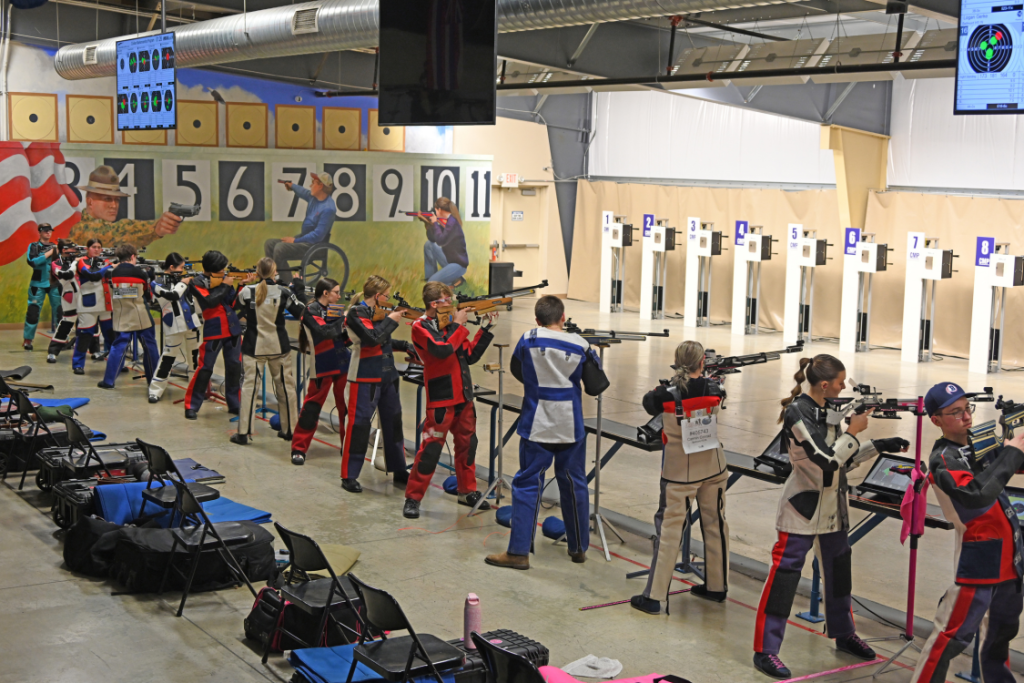
Some Juniors already belong to a Shooting Club that offers them a path forward into adult participation. The CMP has approximately 625 Senior Shooting Clubs that meet this requirement. Many of these clubs have Smallbore Rifle, Bullseye Pistol or Highpower Rifle ranges and programs that are open to their Juniors. These clubs can play a vital role in encouraging their juniors to continue participating in one of these competition disciplines after their Junior eligibility is exhausted. Many of these clubs already encourage their Juniors to compete with their club teams in open competitions. Juniors in these clubs have often been that club’s “new shooter” or a firing member in the club’s team in the National Trophy Team Matches at Camp Perry.
What Should Club Members and Juniors Do? For this model to work, the club’s senior division must have range facilities and a program that supports one or more traditional Shooting disciplines like Match and EIC Pistol, Smallbore Rifle Position or Service Rifle EIC and XTC (Across the course). Juniors who show an interest in learning about their club’s Senior Shooting disciplines should receive the club’s encouragement and full support. Club leaders should offer their Juniors opportunities to shoot with their Seniors. The club may need to offer loaner rifles or pistols; they may even need to provide ammunition at low or no cost. Clubs with Juniors who shoot sporter class air rifle events may need to provide loaner shooting jackets to get Juniors to try Highpower or Smallbore Rifle Position. Assigning experienced senior competitors to mentor interested Juniors is important.
These clubs can also play a guiding role in encouraging Juniors to acquire their own equipment which will be essential to their continued post-junior participation. When encouraging Juniors to compete with Seniors, there are some precautions to note. Clubs with Pistol teams need to have their Juniors stick with .22 rimfire pistols until their joint growth reaches maturity. Clubs with smallbore rifle programs should encourage their Juniors to focus on three-position and Air Rifle standing competitions where future growth is likely.
2: HIGH PERFORMANCE SHOOTING
COMPETITION
High Performance Shooting encompasses membership on an NCAA College Rifle Team, engaging in one of many forms of elite training and ultimately qualification for USA National Teams that compete in ISSF Championships. Juniors who want to advance into High Performance Shooting must already be shooting top scores. They should consistently be qualifying for finals in Junior competitions. It’s important to set goals early and to engage in daily, intensive training. Participation in High Performance competition is reserved for Juniors who set high goals and who work hard to achieve those goals. There are two or three critical aspects to this level of competition shooting that Juniors, and their coaches and parents, must consider:
• Obtaining Personal Equipment. For Juniors who want to shoot in college or continue in elite competition, it is pretty much mandatory that they have their own high-quality equipment. Many successful Junior programs provide loaner rifles and rifle clothing or pistols for their Juniors but any Juniors who want to advance into High Performance competition need to start planning to acquire their own equipment. Rifle shooting equipment, in particular, can be quite expensive. Position Rifle competition usually means competing in both Smallbore Rifle Position and Air Rifle Standing events. Competition grade Smallbore Rifles can cost $5,000 or more. Top grade Air Rifles cost $3,500 or more. With a thousand dollars or more that must be invested in a shooting jacket, trousers and other equipment, the total cost for equipping a rifle competitor will likely be $10,000 or more. With the need to make such a significant investment to be competitive in High Performance Smallbore and Air Rifle competitions, it is important for experienced adult competitors to serve as advisors for Juniors and their families as they acquire the equipment they need to compete.
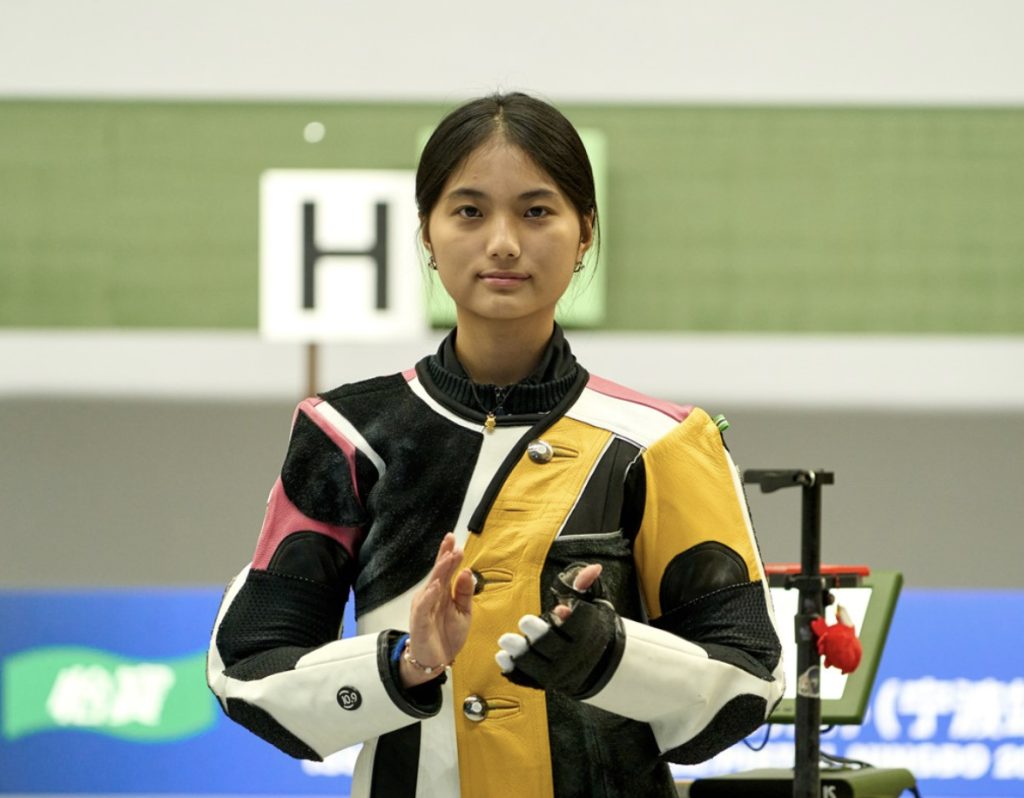
• Catching Up with World Leaders. A challenge facing the USA Junior rifle and pistol athletes who want to continue in national and international-level competitions is that the best U. S. Junior rifle athletes are shooting scores that are lower than scores fired by the best Juniors from China, Korea, India and even some European countries. The highest 10m Air Rifle scores currently being fired by the best USA Juniors approach 630.0/631.0. BAN Hyojin from the Republic of Korea shot a 634.5 to lead Olympic qualifiers in the 10m Air Rifle Women event at age 15. She fired 633.0 to lead World Championship qualifiers at age 16. This year, 16-year-old PENG Xinlu from China raised the 60-shot women’s World Record to 637.4. USA Junior rifle athletes are behind their counterparts from East Asia. The gap in pistol is even greater. USA Pistol Juniors are not competitive in international championships. One of the challenges facing high performance Shooting programs in the USA is to provide the coaching and training opportunities that will close these performance gaps.
• Advanced Coaching Programs. A new factor in the development of elite juniors in the USA has been the emergence of advanced coaching programs that offer professional, high-performance coaching on a commercial basis. These programs offer in-person private coaching and online private coaching. The quality of the coaching is top-notch. TWS founder Lucas Kozeniesky is an Olympic silver medalist. Jayme Shipley of iShoot Consulting’s has a resume that lists five international medals and a 5th place Olympic finish. Natalia Tobar Prado of Five Rings Performance is a Pan American Games medalist. Juniors who seek to advance to the world-class level should consider these programs as a means of obtaining advanced coaching. The three advanced coaching programs that are currently working with USA athletes are:
o Team Winning Solutions LLC (TWS). https://twsolutions.org/. TWS and its six employees are based at Camp Perry, Ohio.
o Five Rings Performance. https://www.instagram.com/five_rings_usa/?hl=en.
o iShoot Consulting. https://www.ishootconsulting.com/.
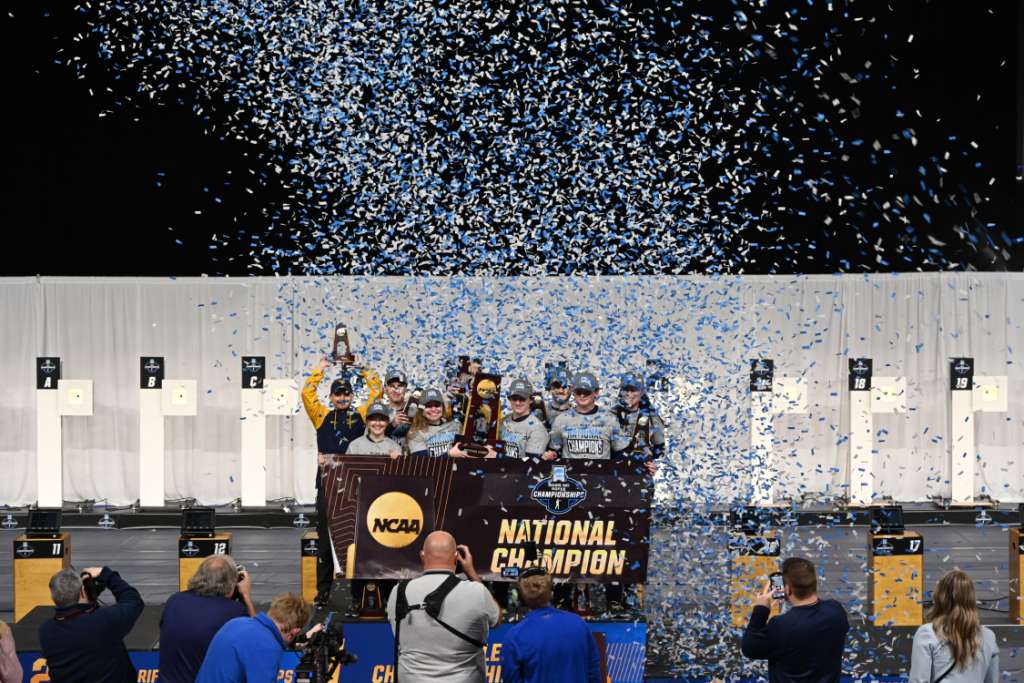
• NCAA College Rifle Program. Leading three-position rifle athletes in the USA are fortunate to have the NCAA Rifle Program that offers them advanced training and elite-level competition. All the most recent USA Olympic rifle medalists are products of NCAA rifle teams: Maddalena 2024, U. of Alaska; Shaner 2021, U. of Kentucky; Tucker 2021, Kentucky/West Virginia; Thrasher 2016, U. of West Virginia; Gray 2012, U. of West Virginia. Currently, there are 28 colleges and universities with active varsity rifle teams supported by their athletic departments. Most of them have scholarship funding. The NCAA Rifle Program is clearly an advanced program where new team members are expected to arrive with personal equipment. The NCAA Rifle season starts in the fall and ends with the NCAA Rifle Championship in March.
The problem, of course, is that with only 28 active varsity rifle teams, the number of opportunities to shoot on a college rifle team are limited compared with the number of junior rifle athletes who graduate from high school each year. Juniors who want to shoot on a college rifle team, need to start preparing for that possibility when they are freshmen or sophomores in high school. The CMP publishes a series of resources on college rifle programs that include a CMP Guide to College Recruiting.
They are posted at https://thecmp.org/youth/college-resources/. The most important action you can take is to do lots of training to get your scores up. Plan to attend the best Junior competitions you can where you will be seen by the college rifle coaches who attend these matches while scouting for new talent.
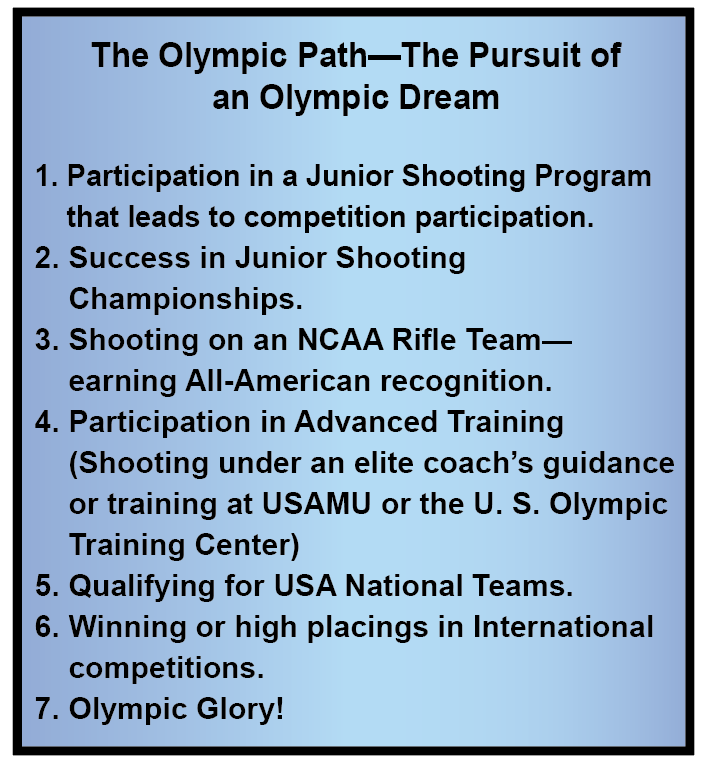
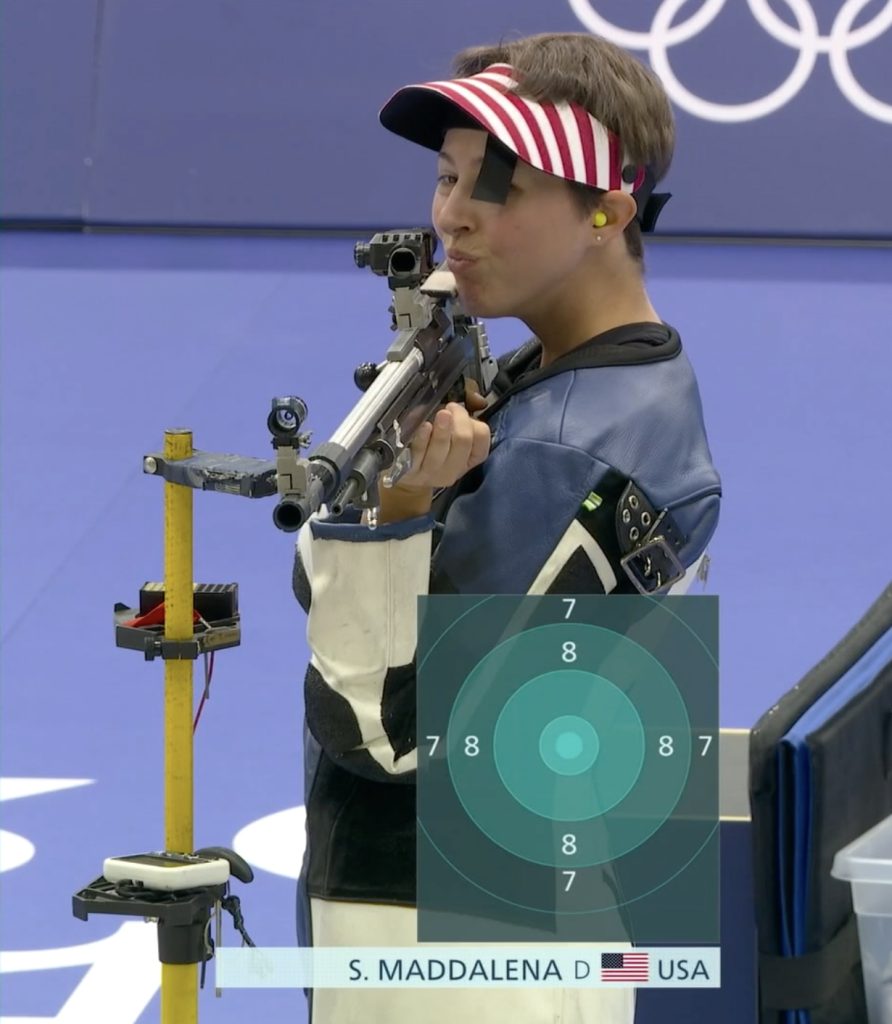
• The Olympic Path. When SSG Sagen Maddalena won an Olympic silver medal in the 2024 50m Rifle Three-Position Women event, her shooting career almost perfectly exemplified the Olympic Path that is a model for becoming a world class shooter. She began Shooting in a 4-H Shooting Sports Club in California. That led to joining the California Grizzlies, an advanced Junior Highpower Rifle program that trains Junior teams to compete in competition up to and including the National Matches. Sagen excelled in this program by earning her Distinguished Rifleman Badge and winning places on the Deneke Trophy National Junior Team in 2011 and 2012. Those successes led her to compete on the University of Alaska College Rifle Team where she earned multiple All-American honors. After graduation, she enlisted in the Army and was assigned to the Army Marksmanship Unit based on her collegiate shooting accomplishments. SSG Maddalena was a USAMU Soldier when she won a World Cup Final gold medal in 2021 and a World Championship bronze medal in 2023. Today she continues to train and compete with the USAMU International Rifle team. She has earned the rank of Staff Sergeant. Juniors who aspire to greatness should learn as much as they can about SSG Maddalena’s path to Olympic glory because it exemplifies the Olympic Path so well.
3: SENIOR COMPETITION SHOOTING IN RIFLE OR PISTOL DISCIPLINES
The world of Senior competitions that is ready to welcome young people who are aging out of their Junior Programs encompasses traditional Shooting disciplines where competitors pursue recreation-oriented goals. Within this universe, there are two types of participants: 1) Competitors who participate in competition events that range from local club matches to the National Matches at Camp Perry, and 2) Recreational Shooters who shoot because they enjoy the challenges of personal marksmanship, without any involvement in serious competition. If you are a Junior who is interested in becoming either a Competitor or Recreation Shooter in one of the CMP’s Shooting Disciplines, here are some considerations to help you decide “WHERE DO I GO FROM HERE?”
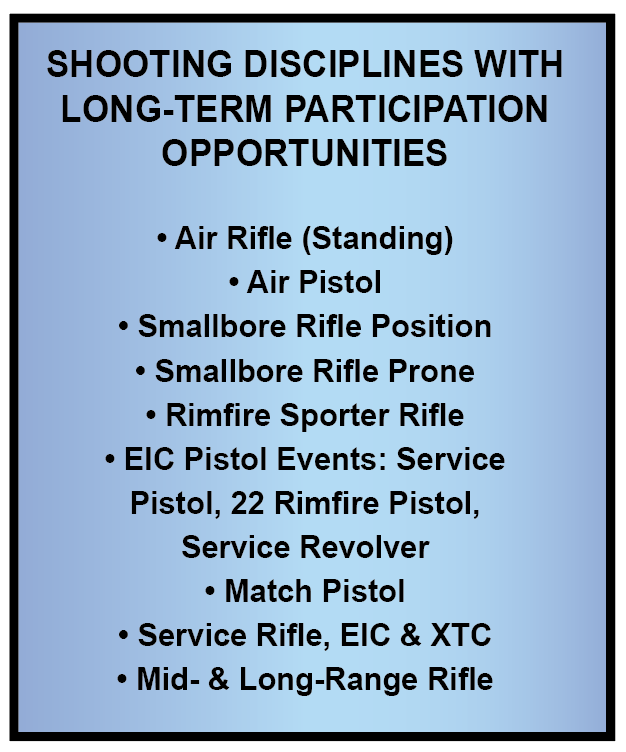
• What Shooting Discipline Should I Try? Shooting sports are divided into “disciplines” that define and govern the type of shooting being done. Air Rifle, Smallbore Rifle Position and Match Pistol, as examples, are Shooting disciplines. Young shooters who want to continue in Shooting need to pick a discipline that they can realistically pursue. The chart here lists leading disciplines that are supported by CMP competition programs. Choosing from among them may be a matter of personal interest, but in most cases your choice depends upon where you can obtain opportunities and mentoring. Juniors who live close to the CMP Competition Centers at Camp Perry, OH, Anniston, AL, and Talladega, AL, will be able to choose from the disciplines those centers support. There are major range complexes in other parts of the country that also support multiple disciplines. However, if a local shooting club has a shooting range designed for a particular discipline that may be the obvious choice for you.
• How to Become a Participant in Your Chosen Discipline. Once you decide which discipline to pursue, try to learn as much as you can about its course of fire, rules and equipment. Some disciplines boost books that provide excellent introductions. Go to a match to observe, learn how discipline competitions are conducted, and meet experienced competitors who typically are eager to assist new shooters. Talk to the top shooters to learn what kind of equipment you will need. Equipment and ammo costs can be a formidable obstacle for young adults whose jobs, income and family situations are not yet established. To get you started, an experienced shooter in your club or area may be willing to loan a rifle or pistol. Develop a plan to save the money you need to buy necessary equipment. Once you get your hands on the necessary equipment, look for opportunities to practice the course of fire before you go to any matches. In due course, you will be ready to start shooting matches in your new Shooting discipline. With the skills you have developed in Junior Shooting, you are likely to advance rather quickly through the ranks of competitors in your chosen discipline.
• Transitioning from Air Rifle Sporter Class to Rimfire Sporter Rifle. The most popular Three-Position Air Rifle event is the sporter class competitions where air rifles are limited to a $700 maximum cost. Most sporter competitors use club or team equipment and do not even have their own equipment. Each year there are tens of thousands of them who have had great experiences in sporter class competitions who graduate from high school. The most accessible open competition for them to try is Rimfire Sporter Rifle. Like sporter class air rifle, Rimfire Sporter uses ordinary 7 ½ lb. rifles that are weighed with sights (there is an optical sight category that is limited to 6x telescopes). Rimfire Sporter also does not allow shooting jackets or trouser which means sporter class air rifle athletes are already prepared to comply with Rimfire Sporter firing conditions.
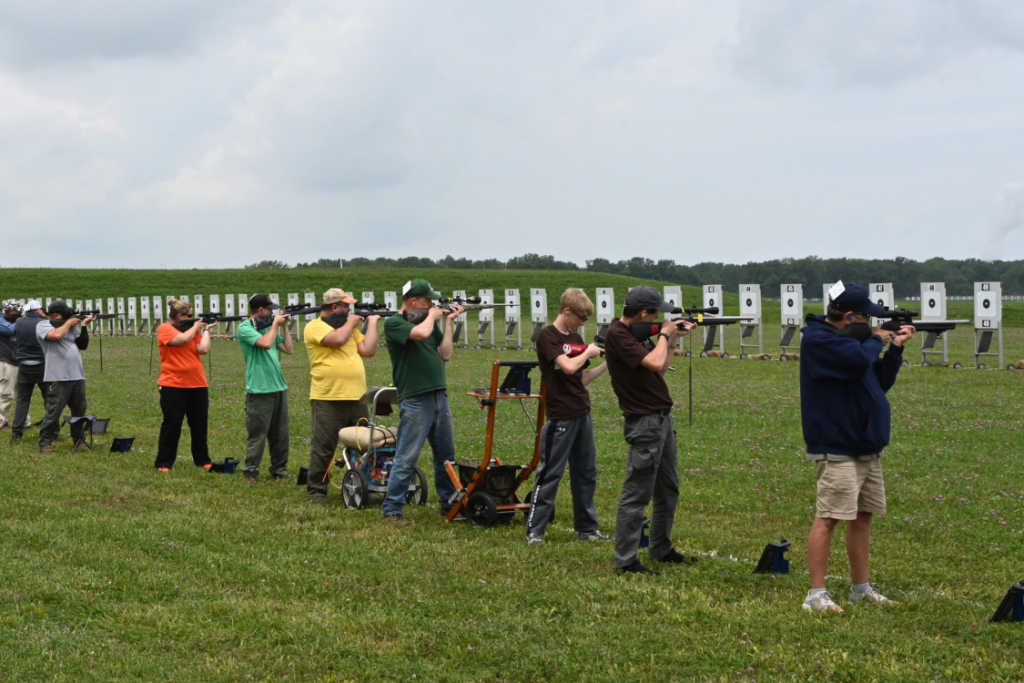
• College Rifle and Pistol Clubs. High school graduates who attend colleges will find that most colleges and universities do not have varsity rifle programs but that they may have a rifle or pistol club they can join. You may need to have your own equipment, but many of these clubs have access to ROTC ranges where club practice can be done. The shooting programs pursued by these clubs may vary from shooting in competitions with other clubs to periodic meetings for club shooting sessions. If you are going to college this is an opportunity to continue shooting that is worth checking into.
• CMP Award Programs. The CMP has two major award programs that can provide goals for your advancement in Senior Shooting disciplines.
o Achievement Medals. The CMP Achievement Medal program provides Gold, Silver and Bronze Achievement Medals to competitors who exceed established cut scores. Awards are based on recognizing the top 40 percent in each designated event. Many of these events are Vintage Military Rifle events where very few young shooters participate, but these popular medals are presented in Rimfire Sporter events where lots of younger shooters compete.
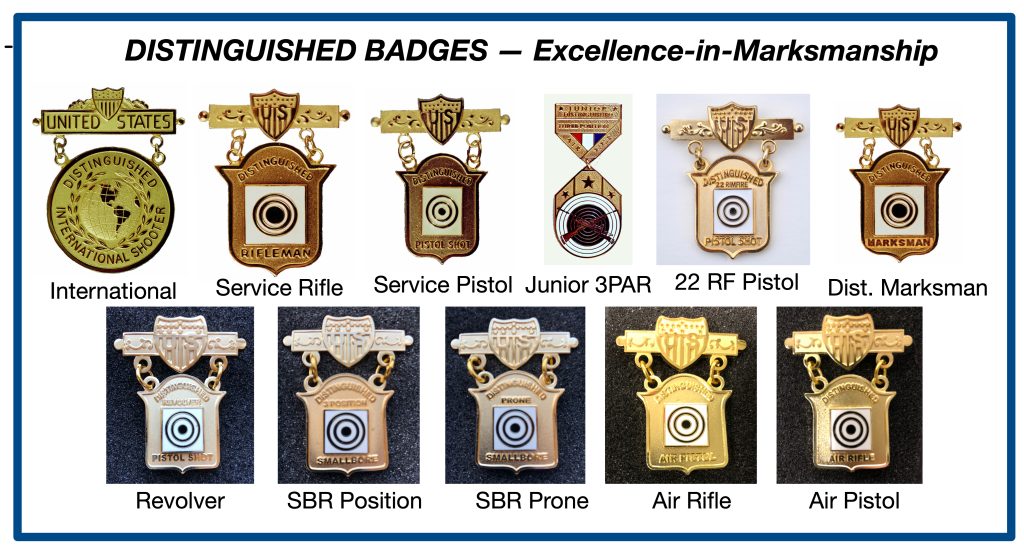
o Distinguished Badges. Gold Distinguished Badges are the highest individual awards authorized by the U. S. Government for excellence in marksmanship competition. In each of the 12 shooting disciplines where the CMP awards Distinguished Badges, match sponsors conduct EIC (Excellence-in-Competition) matches where the top ten percent of non-Distinguished competitors received 10, 8 or 6 credit points that count towards the 30 points needed to earn the badge. For many competitors in these disciplines, their most important goal is to become “Distinguished.”
One Last Appeal. Junior athletes are the ones who must decide to continue participating in the Shooting Sports after they graduate from high school or college, but very few of them will be in a position where they can make the transition from Junior Shooting to Senior Shooting without support and mentoring from Senior club members and experienced competitors. If you are a Senior club member or experienced competitor, please look for ways that you can help Juniors become active competitors in open or Senior Shooting disciplines.
It would be nice to see cheap fees for 18 and under at events like D-day at Talledega. Last time I attended just a bunch of us old guys and we need the young people to keep it going. Just my .02
Well written. Sadly, a competitive firearm, match grade ammunition, range time, clothing, targets and equipment are no longer furnished and former free time must now be used to earn a living wage to pay for ridiculously expensive housing and transportation. This means the ability to focus mentally, physically and socially on regional, national and international practice and competition is pretty much limited to those who have already been targeted by either the AMU or USA Shooting for support and further development. CMP’s Rimfire Sporter program is helping to keep alive rifle competition and a similarly rewarded program from CMP for .22LR pistol might do well in promoting it also.